This article explains what pilot scholarships are, which UK organisations offer them, who can apply and how to make an application. A scholarship pays for part or all of a pilot's training.
*Published 7 November 2025. The award figures and dates are from that date. Check each provider's current rules before you apply.*
## What pilot scholarships do
A scholarship gives you money and support for flight training. Training costs are usually the largest barrier for people in the UK who want to become pilots. Scholarships reduce that cost.
Aviation organisations fund scholarships to support future pilots. Many people have the ability to fly but not the money to train. A scholarship covers part of the training cost, and for some awards most of it.
### What Do These Scholarships Actually Cover?
Instead of just a cheque in the post, a pilot scholarship typically offers a full-blown training package. It’s all carefully structured to help you hit those key milestones on your way to earning your wings.
- **Your First Taste of Flying:** Many scholarships, especially those for beginners, will cover your first block of flight hours. This gives you a solid, practical foundation to build upon.
- **The Full Licence:** The most prestigious awards can fund an entire Private Pilot Licence (PPL). That’s a qualification worth over **£10,000** and the absolute cornerstone of any professional pilot’s career.
- **Mentorship and connections:** Some scholars get access to experienced pilots and industry contacts. They can give advice and career guidance.
> A scholarship pays for training. It also shows that an organisation has chosen you from a competitive group.
Scholarship panels look for dedication, aptitude and a real interest in flying. The support lets chosen applicants concentrate on learning to fly.
## Exploring Different Types of Pilot Scholarships
Scholarships differ in size and purpose. They range from introductory flying experiences to full training packages. Each suits a different stage of training. Understand the differences, and then apply for the awards that fit your goals.
Some scholarships give a first experience of aviation. They are often gliding scholarships or bursaries for a set number of flight hours. They suit beginners who want to find out whether they like flying, without a large financial risk.
### From First Flight to Full Licence
Other scholarships cover more. Some awards cover **10 to 15 hours** of powered flight training. This is a significant contribution towards a licence. These awards are usually for people who have already shown commitment to aviation, for example through volunteering or a few self-funded lessons.
Then you have the holy grail: the full Private Pilot Licence (PPL) scholarships. Valued at over **£10,000**, these awards can cover almost all the costs of getting this foundational pilot qualification. A full PPL scholarship is a life-changing opportunity, taking someone from enthusiast to qualified pilot and opening the door to a professional career.
The infographic shows that a scholarship can include support as well as money. 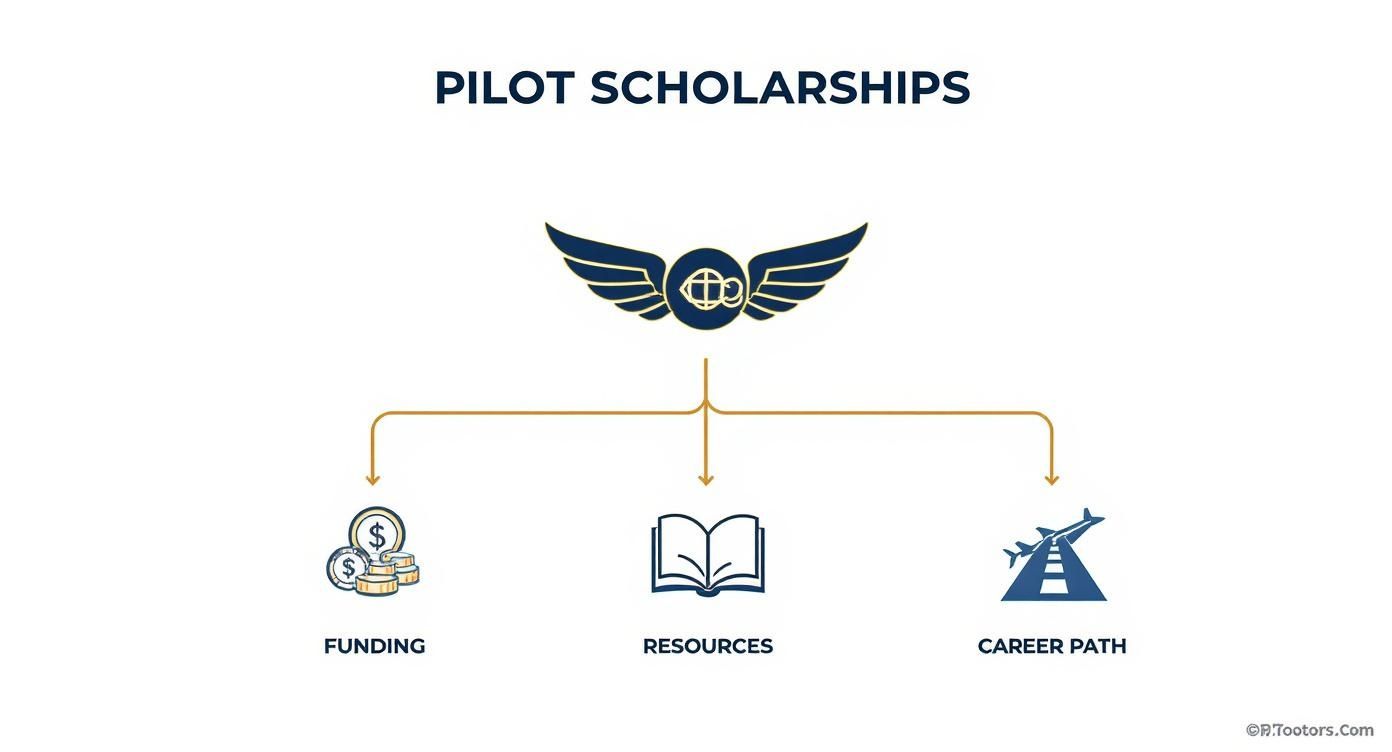 As you can see, the best awards provide funding, mentorship, and career development all in one.
### Matching the Scholarship to Your Ambition
Choose a scholarship that matches your experience. A complete beginner can apply for a gliding scholarship. A person with a few hours in the logbook can apply for a larger flight training award.
To help you see the differences more clearly, here's a quick comparison of the main scholarship types you'll come across.
### Comparison of UK Pilot Scholarship Types
| Scholarship Type | Typical Training Provided | Ideal for... | Leads Towards | | --- | --- | --- | --- | | **Gliding Scholarship** | Initial gliding lessons (up to solo standard) | Complete beginners wanting a low-cost start. | A solid foundation in airmanship and 'stick and rudder' skills. | | **Flight Hour Bursary** | A block of powered flight hours (e.g., 5-15 hours) | Students who have started training but need help to continue. | Progressing towards a PPL or NPPL. | | **Full PPL Scholarship** | All training costs for a Private Pilot's Licence. | Highly motivated individuals with a clear career ambition. | The first major qualification for a professional pilot career. | | **Specialist Award** | Advanced training (e.g., Instrument Rating, aerobatics). | Qualified pilots looking to specialise or advance their skills. | A specific career path like instructing or airline flying. |
Each scholarship is a step. Choose the next step that matches your experience.
There is probably a scholarship for each stage, from a first solo to a full PPL. See our [Funding](/fund) page to start your research. Match each award to your goal, and then make your application.
## Key Providers of UK Aviation Scholarships
A few organisations in the UK offer most pilot scholarships. These are the names that you will see most often when you search for a **scholarship for piloting**.
Getting to know who they are and what drives them is the first step. Each one has its own mission, whether that’s getting more young people into flying or championing diversity in the cockpit. By understanding them, you can tell your story in a way that really connects with their goals.
Let's break down three of the most important providers to help you focus your efforts.
### The Air League: A Hub for Aspiring Aviators
The Air League focuses on young people. It offers scholarships for both gliding and powered flight.
The Air League describes itself as the UK's largest provider. Over the last decade, it has put over **£2.5 million** into funding young talent. In the year before this article, it awarded **90 scholarships**: 56 for powered flying, 31 for gliding and 3 for electric flying.
Read the [2025 scholarship programme on the Air League website](https://airleague.co.uk/news/the-air-league-launches-2025-aviation-scholarship-programme).
Their website lays out all the options really clearly.
As you can see, they neatly categorise the awards, so you can quickly find the right fit, whether your passion is for gliding, engineering, or powered flight.
### The Honourable Company of Air Pilots
If you’re dead set on a professional career, then The Honourable Company of Air Pilots is a name you need to know. This is a historic organisation dedicated to upholding the highest standards in aviation, and they back this up by funding some seriously intensive training programmes.
Their scholarships are among the most prestigious you can get. They are highly competitive, especially for the Private Pilot Licence (PPL), and they demand real commitment. Often, you'll be expected to complete all your training over a single summer. It's tough, but perfect if you're ready to go all-in and fast-track your qualifications.
> An award from The Honourable Company of Air Pilots is recognised across the industry.
### British Women Pilots’ Association: Championing Diversity
The British Women Pilots’ Association (BWPA) is on a mission to make the flight deck a more inclusive place. Their core focus is to support and encourage women in aviation, and their scholarships are central to that work. They offer a growing number of awards that help at various stages of training.
The BWPA and its partners fund the scholarships. They aim to reduce barriers for women in the industry. Applicants can also contact the BWPA network of women pilots for mentorship and support.
A BWPA scholarship gives funding and access to a community of women pilots.
## Eligibility and application timeline
Each provider has its own criteria. Read them before you apply. A missing detail can make an application invalid. Most providers share the common criteria below.
1. **Age.** Most scholarships are for people aged **16 to 25**. There are exceptions. 2. **Medical.** You must be medically fit to fly. This usually means a Class 2 Medical Certificate. 3. **Flying experience.** Many awards are for complete beginners. Providers often consider your interest and potential more than your logbook.
### The annual application cycle
Most providers follow an annual cycle. Plan your application before the window opens. A missed deadline means your application will be rejected.
The typical timeline is:
- **Late autumn (November and December):** Application windows usually open. Prepare your personal statement and your documents.
- **Winter (January and February):** Deadlines usually fall in this period. Submit your application before the deadline.
- **Spring (March and April):** Shortlisted applicants attend interviews or assessment days.
- **Late spring and early summer (May and June):** The provider tells successful applicants. Training plans are agreed.
> Apply in good time. A timely and complete application shows that you plan carefully.
### Example: The Honourable Company of Air Pilots
The Honourable Company of Air Pilots has an established process. Its application forms usually open in late November or early December. Interviews for shortlisted applicants take place in London in April.
A condition of its awards is that all training must finish by the end of September of that year. Plan your summer for this. Read more about [the Air Pilots' flying scholarships](https://www.airpilots.org/scholarships/flying-scholarships/).
Most providers use a similar timeline. Make a list of the dates of every scholarship that you plan to apply for. Plan your year around these dates.
## How to make a strong application

Competitive scholarships receive many applications. Meeting the basic criteria is not enough. Your application must persuade a panel to invest a large sum in you. Do not only list your grades. Explain why you want to fly.
Explain your reasons for choosing aviation. Describe obstacles that you have overcome. Show the panel that you can continue when training is difficult. Selectors want to know these things.
### Weaving Your Personal Story
The personal statement is where you make your case. Give evidence of your interest in flying. Do not only state it.
Give specific examples. For example, you volunteered at a local airfield every weekend, or you built a flight simulator, or you studied aviation theory in your own time. These details show your commitment.
Your goal is to demonstrate the core qualities of a pilot:
- **Leadership:** When have you taken charge of a project or team?
- **Resilience:** Tell them about a time you failed, what you learned, and how you bounced back.
- **Problem-Solving:** How do you tackle a complex challenge when you don't have all the answers?
This is what turns a standard application into a memorable one. For a step-by-step guide on how to build this narrative, check out our in-depth [**application guide**](/fund).
> Your application must show your interest in flying. It must also show that you understand the responsibility of being a pilot.
### Highlighting Diversity and Unique Perspectives
The aviation industry is making a real push to become more inclusive, and scholarship providers are often at the forefront of this movement. Many are actively searching for candidates who bring different life experiences and perspectives into the cockpit.
Some organisations have increased their support. The British Women Pilots' Association (BWPA) grew from seven awards in 2019 to **23 scholarships** by 2022.
Don't shy away from what makes you unique. Your background isn't a box to tick; it's a strength. Confidently explain how your perspective will enrich the aviation community and contribute to its future.
## Answering Your Top Pilot Scholarship Questions
Even with a clear plan, you're bound to have questions. And when it comes to something as big as funding your pilot training, getting solid answers is the key to moving forward with confidence.
These are common questions from people who plan to apply.
### Do I Need Flying Experience to Apply?
This is the big one, isn't it? The great news is that for most entry-level scholarships in the UK, you absolutely **do not** need any previous flying experience. In fact, many providers, like [The Air League](https://airleague.co.uk/flying-scholarships), design their awards specifically for total beginners.
Panels look for potential. They want to see real interest in aviation and the right attitude. Your drive matters more than the number of hours in your logbook. More advanced scholarships can expect some flight time. Read the requirements of each scholarship.
### What Costs Does a Scholarship Cover?
This varies. Look at what each award offers. The support depends on the award.
- **Introductory Awards:** Some scholarships are designed to give you a taste of flying. They might offer a bursary for a few gliding lessons or a small block of powered flight time.
- **Partial funding:** Other awards cover for example **10 to 12 hours** of instruction. This reduces your overall training costs.
- **Full Licence Scholarships:** These are the holy grail. A full Private Pilot Licence (PPL) scholarship can be worth over **£10,000**, covering pretty much everything from training fees to exams and essential kit.
> Read the terms. Check what the award includes: flight time, ground school and exam fees. Check what you must pay yourself, for example travel to the airfield or accommodation.
### How Competitive Are Pilot Scholarships?
Scholarships are competitive. A single scholarship can receive hundreds of applications for one or two places. Your application must be strong.
Meet all the eligibility criteria. Then show your motivation and your ability to continue when training is difficult. Use examples from your life, such as academic work, volunteering or personal projects.
### Are There Scholarships for Women or Underrepresented Groups?
Yes, absolutely. The UK aviation industry knows it needs to improve diversity, and many organisations are putting their money where their mouth is. They're actively creating programmes to ensure the flight deck better reflects our society.
The [British Women Pilots' Association (BWPA)](https://bwpa.co.uk/scholarships/) runs a scholarship programme to help women become pilots. Other providers also state that they welcome applications from people from all backgrounds. Read each organisation's values. If your story matches its mission, say so in your application.
* * *
To compare funding routes, see our [Funding](/fund) page. CloudFunder does not lend money or sponsor trainees.